Category: Korean Kitchen Hacking

  • Crispy Onions Rings made with SOJU!

    Crispy Onions Rings made with SOJU!

    Onion

    Sometimes we make mistakes at the restaurant. They’re not big mistakes. The fry station will sometimes make too many of an item. Or really, they make a few extra onion rings or fries just in case a couple don’t turn out. The extras we dump into a bowl as the evening progresses. If we end up with a good amount by the close of business, we like to cover it in chili and call it a “Dump Truck,” enjoying it with that post-shift beer.

    I’m telling you this because one night, I delved into the Dump Truck and noshed on a multi-hour old onion ring. It was still light and crispy. Not greasy. It came from our new little experiment that we’ve implemented at OK Burger on the Cheonggyecheon.

    Let me share it with you.

    There are so many ways to make onions rings. The thing is, they’re temperamental. It’s hard to get them just right, and when you do, they deteriorate quickly. A lot of foreign bars in Seoul use beer batter, and it works just fine. We were using beer batter here. It’s classic. The thinking is that the bubbles in the beer help lighten the batter as it fries, making light onion rings. But as we all know, anything with carbonation goes flat. So really, you end up with flat beer batter. It flavors them just fine, but they can feel heavy after a while. One thing that living in Korea has opened my eyes to is how heavy fried foods can make you feel. Being on a diet of non-fried foods has made me more sensitive to onion rings, fish and chips, and my old favorites.

    The challenge is that I wanted to make them lighter. Maybe more of a tempura style. One way I had known in the past was to use club soda. That’s how some Japanese tempura chefs do it. Like the beer, though, you need to use it right away. Then I heard about some places in America that were trying something new–vodka. The science is that vodka has a lower boiling point than water. It evaporates more quickly, and frying is basically just rapidly drying out foods. So foods fried in a vodka based batter come out lighter. Now, vodka is still quite pricey in Korea. But we have one very affordable substitute.

    IMG 20150925 125611

    SOJU.

    It was under our noses all along. It took a few experiments, and we had staff and customer volunteers try them. They couldn’t taste the soju, but they liked the crispier texture. The trick was getting the right ratio of frying powder and soju. Doing it like you normally make beer batter made them too much like tempura. That’s a good thing if you want tempura. It’s mesmerizing watching the batter hit the hot oil, bloom out, and crystallize like crispy snowflakes. When they’re that delicate, they’re difficult to season. The crust just disintegrates and falls off, and you’re left with naked onions. You want something more akin to a thick pancake batter. And really, it works!

    At OK Burger we serve them with our housemade smoky ketchup, and they’re addictive. We’ve noted that plates that go out with onion rings on them come back empty.

    [box type=”info”] UPDATE: OK Burger on the Cheonggyecheon is now closed, but you can still do this at home.[/box]

  • Korean Kitchen Hacking: Lasagna almost totally from scratch

    Korean Kitchen Hacking: Lasagna almost totally from scratch

    Korea has gotten much better for finding foreign products than when I started this blog. But some stuff is still difficult to find. One thing I have never made in Korea is lasagna. That already requires a good bit of work even if you do have ingredients on hand. What got me started was finding lasagna noodles at Home Plus. They’re partnered with Tesco in the UK, so they have lately become the best bet for finding western products at a decent price.

    So I had the pasta. I also have an oven, which admittedly, isn’t as common as you’d think in Korea. One of the best investments I’ve ever made. Since ovens aren’t common, oven accessories aren’t that common either. It wasn’t until I decided to make lasagna that I realized how hard it was to find something like a Pyrex dish. I looked in Home Plus, E-Mart, and New Core Department Store. No luck. We went on G-Market (like Amazon). It took some searching, but we found Pyrex dishes. I bought one that would suit my purposes.

    The following is not a recipe. It’s a journal entry of what I did. Here goes.

    8439357171_94f986ea67

    I first had to make the ricotta. You can get ricotta at the supermarket now–for around W10,000 for a tiny tub. I didn’t want to spend W75,000 to make this lasagna, so I got some heavy cream and made my own. (recipe here)

    8440447666_1bf26e95e9

    There we go!

    8439357079_b745cd9c8f

    Next I made some Italian sausage. Why use plain old hamburger beef when you can do sausage? Besides, pork is much cheaper than beef in Korea. I based mine on this recipe. If you have any fennel around, which you can find at the foreign markets in bulk, you can make Italian sausage with ground pork from the Korean butcher. I just replaced the paprika with gochugaru.

    8440447704_b18b4f7a00

    While the flavors were getting to know each other in the sausage, I roasted some peppers for the sauce.

    8440447546_ee12122703

    This is the easiest way to make tomato sauce. I threw the roasted and peeled peppers in a food processor with a couple canned tomatoes, garlic, and onion. Gave that a whir.

    8439356737_8df108dcfd

    Browned the sausage. House started smelling good at this point.

    8439356663_a748ba74c8

    Added the tomato sauce and some oregano. Seasoned it, and let is simmer for an hour or so.

    8440447326_d6e6260f20

    While that was simmering, I whipped up a simple bechamel (brown some olive oil and flour, add milk, salt, and a little nutmeg, whisk constantly on medium heat until it bubbles and turn it off).

    8440447300_012502b230

    Grated some Romano I found at the supermarket.

    8439353421_dc08142f99

    Gave the noodles a boil.

    8439356541_111d872f2c

    Then I layered all the bits together.

    8439356465_17ee2e4a9e

    Added a few packets of “pizza cheese.” Then I put it in the oven for 45 minutes.

    8440446904_dfd0f445dc

    And here it is.

    takei

    8440446834_8392d11e43

    A little for me.

    8440446798_e71df05801

    And Jian liked it, too.


    If you really want to know, the whole thing took five hours from start to tummy.

  • Cold brew coffee: Easy, cheap, delicious and home-made

    Cold brew coffee: Easy, cheap, delicious and home-made

    Following up on the theme of my last post regarding a coffee question from a ZenKimchi reader, I thought I would share my personal method for making cold brew coffee.

    If you ask a coffee connoisseur  to recommend a ‘coffee maker’ for you, they will probably giggle with delight and point you in the direction of something that looks like a chemistry set, only more confusing. More than this, for those of us in Korea, it doesn’t make sense to drop half your paycheck buying an electric burr grinder and espresso machine. In fact, you can still make first rate coffee at home with stuff you probably already have stuffed away in the kitchen cabinet.

    Ladies and gentlemen, for your consideration: Cold brew coffee.

    With summer rapidly approaching, there’s no better time to try cold brewing coffee. There’s no expensive equipment to buy, in fact, you might already have everything you need on hand.

    Cold brewing coffee has several advantages:

    • Minimal investment
    • You don’t need to buy a home grinder. Buy 100 grams of fresh roasted beans from the neighborhood roasterie, ask them to grind for hand drip coffee, and use all the beans as soon as you get home.
    • Make enough coffee for the week (or the day, depending on your habit)
    • Pretty darn simple. The process takes 24 hours, but there’s only about 5-10 minutes of anything resembling work on your part.
    • Less caffeine than other coffee (could be a positive or negative I suppose)

    You’ll need to get yourself a large (I think mine is about a quart) glass jar, you’ll also need some sort of filter. [amazon_link id=”B005SW94B6″ target=”_blank” ]Cheesecloth[/amazon_link] works like a charm, but a metal mesh filter, or even a large coffee filter would probably work in a pinch. You’ll also need another receptacle to pour the brew into while filtering. Pretty much any clean pot or jar you have laying around will work just fine.

    Once you have your supplies and your 100 grams of ground coffee, there’s just a few simple steps.

    1. Pour coffee in jar.

    jar

    2. Pour water in jar (Fill it up to about 4/5th full. It’s a good idea to use filtered water).

    addwater

    3. Stir

    stir

    4. Put the jar in a cool, dark place. This doesn’t even have to be a fridge. Just somewhere about room temperature or slightly cooler and out of the sun. You might stir it from time to time, but I tend to forget to do this and it has yet to cause an explosion or anything.

    steeping
    I just happened to use the fridge for steeping this time, but it’s not mandatory

    5. 12-24 hours later, filter the brew using your filter of choice (Use caution. This can be messy). Once you filter it through once, put the extra coffee grounds in the trash (not the sink!), clean the jar out, and filter it back into the jar one more time.

    ready2filter

    6. Store in the fridge for up to a week.

    enjoy
    Now for the best part!

    The resulting brew will be a concentrate with far less acid and body than you are probably used to with coffee. You’ll need to dilute with something and possibly sweeten to taste. You have several options:

    • Add cold water in at least a 1:1 water to coffee ratio and add ice for a true iced coffee. Sweeten to taste.
    • Hot water, again in a 1:1 ratio, for a hot, low caffeine, cup of coffee.
    • Dilute with milk (whole milk is suggested) to taste.
    • Pour the brew into ice cube trays and freeze. Add the coffee ice cubes to milk or smoothies to add a nice, subtle, coffee flavor. Make sure to put the trays in ziploc bags or something so they don’t absorb other flavors from the freezer.

    It’s a pretty simple method that’s pretty hard to screw up, so you can eyeball the measurements.

    Additionally, there’s a slight variation  of this method called the ‘hot-cold’ brew method. Everything is exactly the same as before, except at the very beginning you fill the jar about 25-33% full with water about 190-200 degrees celsius (30 seconds to a minute off of a boil). Mix it up to make sure all of the grounds are soaked, then let it steep for 1.5-2 minutes. Now fill it the rest of the way with cold water. I recommend using chilled water specifically for this and putting the jar in the refridgerator for the 16-24 hours steep time in order to rapidly bring the mix down to a cooler temperature.

    The argument is that the hot water extracts more of the solubles (including caffeine) from the grounds allowing you to get the best of both worlds; both cold and hot brewing methods. I personally use the hot-cold method, but frankly the jury is still out on which way is better.

    There ya go! Try it, play around with it and tweak it. Cold brew coffee is great for the summer or any time you know you’ll have a busy week and want to make your coffee in advance.

  • Korean Kitchen Hacking: The Turducken Roll

    Korean Kitchen Hacking: The Turducken Roll

    IMG 156991

    Being Korean American, my family had a lot of learning to do in the American culture department. Peeled apple on a chopstick was my lollipop.  I once heard Oprah say that moms who lovingly cut the crust off their kids’ sandwiches – THAT was love.  I needed to know mom loved me so I got her on that right away. Christmas was an awkward time when we’d all sit around and stare at each other before slowly receding to our rooms to read or study.  There was one time we tried to do presents, and I got wire hangers. I don’t think I’ve ever gotten over the trauma of that gem of an experience.  Perhaps the most successful example of how we adapted to the American way of life is Thanksgiving. Once my siblings and I left home to attend college as far away as possible from Texas (Boston, Pittsburgh, Philadelphia, and Chicago), we’d gather at my oldest sister’s house in Philadelphia to do the thanksgiving. It was a perfect holiday. No parents and the freedom to cook amazing thanksgiving dishes we hadn’t had a chance to cook yet. It’s how I discovered how to roast a turkey. We made a green bean casserole that actually tasted good, and it finally made sense to me why people ate them.

    Since coming to Korea, I haven’t done Thanksgiving.  My family here is Korean, and asking them to celebrate Thanksgiving for my sake would be like asking them to observe Kwansaa.  But this is the first year that my sister has come to live with me in Korea.  For us, two is more than enough family to do Thanksgiving.  Of course, that number quickly became ten as close friends were invited to celebrate with us.

    Turkey is essential to Thanksgiving.  That’s why it’s called Turkey Day.  Haddon Supermarket in Oksu-dong has huge turkeys for 125,000 won.  More than the fact that I don’t want to spend an obscene amount on turkey, I have no way for cooking it.  I only have a small convection oven.  So, I found some large turkey breasts at High Street Market in Itaewon, and decided I’d stretch my won by making turducken rolls.  For those of you who don’t know, turducken is a chicken stuffed in a duck stuffed in a turkey.  I was impressed until I read about rôti sans pareil (roast without equal).  In the 17th century, a French gastronomist stuffed seventeen birds inside each other.  Half of these birds are now extinct.

    To start, mix together the garlic powder, cayenne pepper, salt, and black pepper.  Keep the seasoning in a bowl to season each of the meats easily.  Once you’re down with the turducken, the seasoning will be cakey with raw poultry juices, so throw it out.

    Preheat oven to 400 degrees F.

    Cover the turkey breast with a layer of plastic wrap.  Grab a heavy rolling pin or a heavy-bottomed saucepan and pound the turkey breast to an even thickness.  Do the same with the duck and chicken.  In the pictures below, there are three turkey breasts and three chicken breasts because I’m tripling the recipe to feed ten people.

    IMG 1530101  IMG 1532101

    IMG 1533101  IMG 1534101

    IMG 1535101
    I couldn’t find duck breast so I used sliced duck.

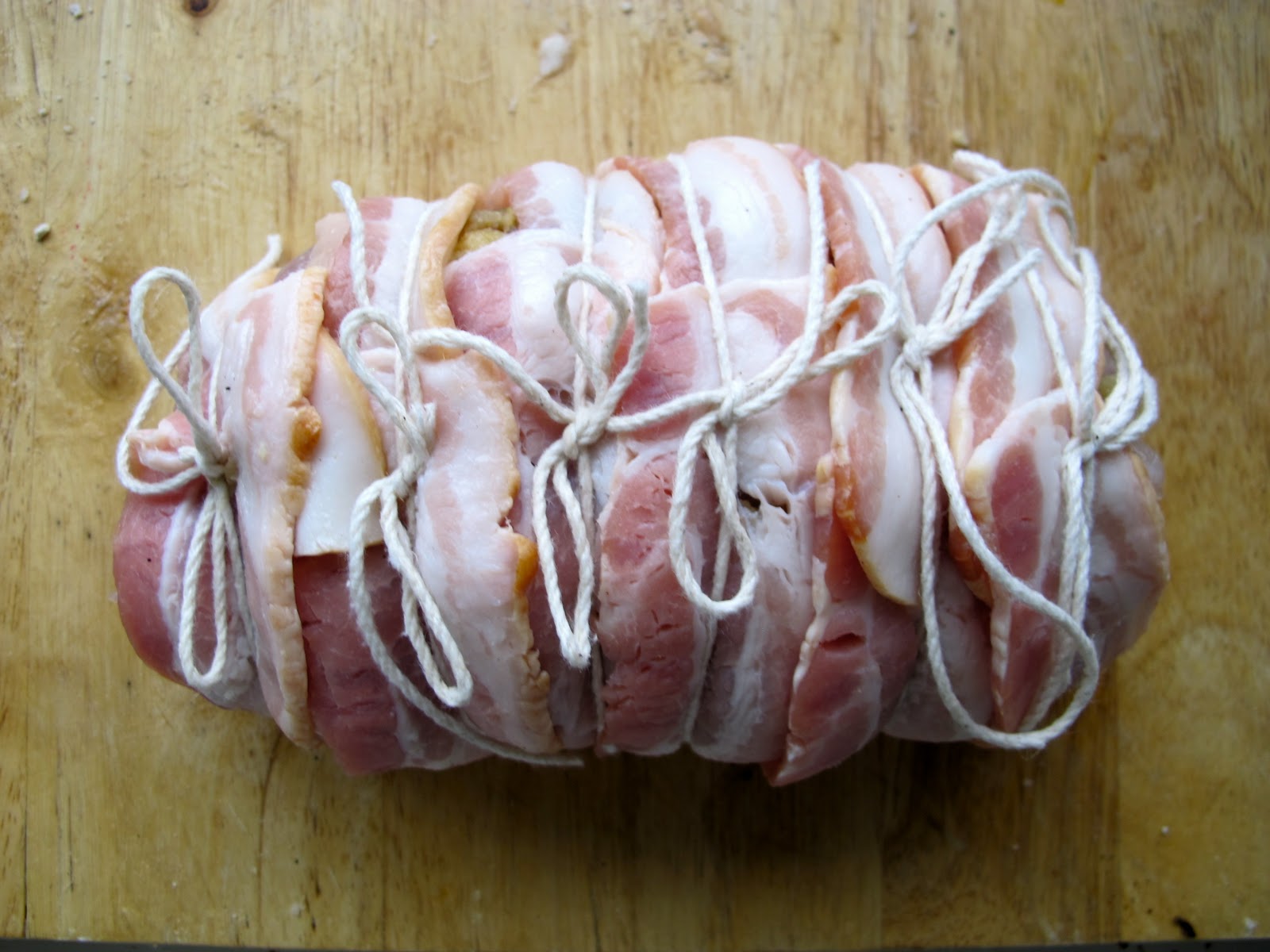
    Lay out the bacon strips side by side with a length of twine running under the middle of each bacon slice.  The twine should be cut so that it’s about two inches longer than the bacon slice on both ends.  If you’re using toothpicks, you can skip this step.


    IMG 1562101

    On top of the bacon, center the turkey breast.  First season the turkey breast with a few healthy pinches of the garlic powder, salt and pepper seasoning.  Spoon about 1/2 – 3/4 cup of the prepared stuffing and spread it into an even layer.  I used boxed stuffing, and made a separate stuffing to be served with the meal.  Whatever stuffing you decide to use, be sure it has small croutons.  You can also use a rice stuffing.

    IMG 1541101


    IMG 1544101

    Next, top the turkey and stuffing with the duck.  Season it.  Then top it with a thinner layer of stuffing, using about half a cup of stuffing.

    IMG 1546101


    IMG 1548101


    IMG 1549101

    Layer with the chicken breast.  Season.  Spread the stuffing but use a very small amount.

    IMG 1551101

    Roll the two long sides up like a taco shell and fold it into a roll.  Bring up the two sides of the bacon to wrap the turducken roll.  Then use the twine to tie the turducken up.  Or use toothpicks to secure.

    IMG 1565101


    IMG 1564101


    IMG 1558101
    So cute I wanted to coddle it over my shoulder like my little bacon baby.
    IMG 1559101
    IMG 1573101

    Place the turducken in a roasting pan.  Tent a sheet of foil over the turducken so that it doesn’t burn.  Cook for 45 minutes then remove the foil and spoon the pan drippings all over the top of the roll so it doesn’t dry out.  Cook for another 30 minutes or so until the internal temperature of the roll reaches 165 degrees F (74 degrees C).

    Let the roll rest for 10-15 minutes.  Then serve.  Use the pan drippings to make a quick gravy.

    Three Birds and A Pig Gravy
    Pan drippings (about 1/4 cup)
    4 tablespoons flour
    4 cups chicken stock or broth

    Over medium heat, whisk the flour into the pan drippings to create the roux.  Whisk for about two minutes until the flour is cooked and the roux is a nice, golden brown paste.

    Then whisk in the chicken stock/broth.  Bring to a boil then simmer until the mixture is reduced by a third.  Season with salt and pepper.  You can choose to strain the gravy if you want it perfectly smooth.

    IMG 1615101
    All the things that still need to finish in the oven (except the pumpkin pie).
    IMG 1655101

    I look like a hungry homeless person because I had been cooking for TWO DAYS STRAIGHT.

    IMG 1664101
    IMG 1658101
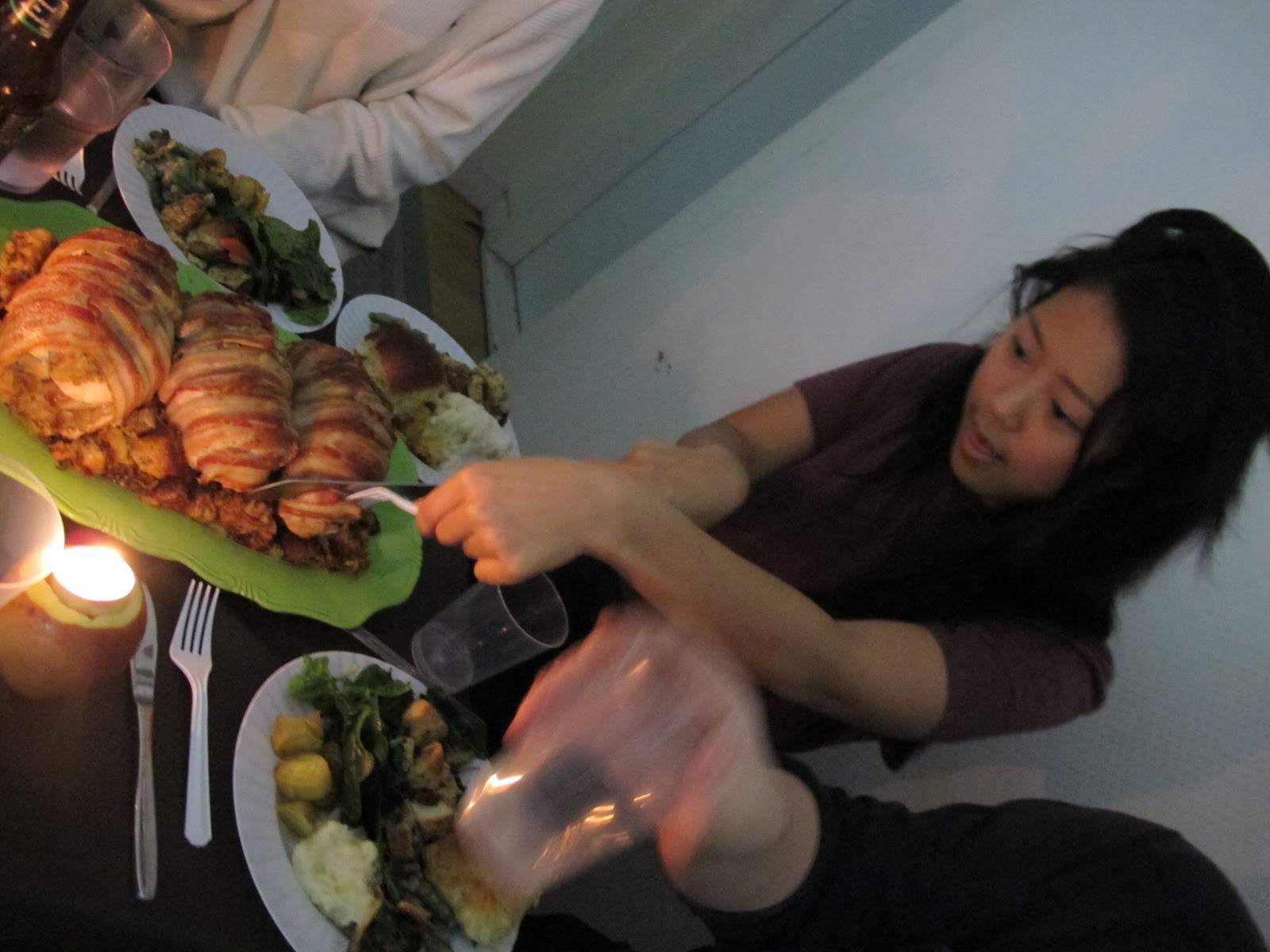
    Served over a bed of smoked oyster and bacon stuffing.
  • Korean Kitchen Hacking: Pressing Cheese in a Sink Drainer

    Korean Kitchen Hacking: Pressing Cheese in a Sink Drainer

    IMG 8959221

    EDITOR’S NOTE: Joyce is our newest writer at ZenKimchi. You can also catch her and her kitchen hacking skills at the amazing blog Knifing Forking Spooning.

    Making cheese isn’t something I’ve ever been interested in. I’ve just been interested in eating it. It wasn’t until I came to Korea that my interest for cheese consumption collided with cheese production. After realizing I could make my own cottage cheese and ricotta, it wasn’t a big leap to making pressed cheeses.  The largest obstacle in making cheese isn’t the process; it’s getting the materials. Rennet can be purchased online in Korea, but cheese cultures are a bit more difficult to procure. The beauty of ricotta salata is that it doesn’t require any special ingredients like rennet or cultured buttermilk. The hardest part is waiting for the cheese to cure for at least two weeks.

    I’ve already posted on my own blog about making a cheese mold and pressing out a ricotta salata. This post is still about ricotta salata, but instead of laboring over making a cheese mold, I’ve found that it’s much easier to use a sink drainer.

  • How to make Chicken Chipotle Tostadas in Korea

    EDITOR’S NOTE: Chipotle peppers recently turned up at local E-Marts. In celebration of this find, guest blogger Noe A. has given us this recipe. It’s not a Korean dish, but it’s another dish that people living in Korea can make. Avocado is optional, corn tortillas can be substituted with flour tortillas, and lemon juice can replace lime juice. Cilantro can also be found in Chinese grocery stores.

    When it comes to international food, it may be difficult to come across a restaurant which provides both the authenticity and taste to backup their menu. Notably, despite the simple ingredients used to prepare Mexican food, finding a good Mexican restaurant can be tough in Korea, even in Seoul. Here is a quick and easy recipe for anyone wishing for nostalgic moment from back home featuring Chipotle Peppers in Adobo Sauce.

    Ingredients
    Chicken (whole or with bone)
    Chipotles in Adobo Sauce cans (can be found in Itaewon Foreigner Food Martket & Emart now)
    Sliced onions
    Corn/Vegetable Oil* (Not soy nor olive)
    Salt
    Avocado or guacamole
    Corn Tortillas
    (Shredded Cheese Optional)
    (Sour Creme Optional)

    Boil the chicken for 90 minutes with sliced onions and add salt.
    Afterwards, cool down and debone.

    On a skillet, add the chicken and 2-3 small cans of Chipotle in Adobo Sauce. Keep stirring on low flame.
    Personally I crush the peppers into smaller pieces while stirring but you can slice them up before if you prefer, just be sure they are small pieces. Add slices of onion. And keep mixing.

    You can buy frozen corn tortillas in either the International Food Market or Foreigner Food market in Itaewon. Probably in eMart or homeplus too.

    On a skillet add the corn or vegetable oil. Once it is heated enough, add a whole tortilla until it is crispy and light golden brown.
    Should be quick. Set aside on a dish covered with napkins to absorb the oil.

    Repeat until you have the desired amount. Salt lightly afterwards.

    Get a tostada, top with the chicken chipotle mixture.
    Add slices of avocado.

    Optionally add Pico de Gallo*
    Optionally use guacamole instead of avacado*
    Optionally add cheese or sour creme*
    *Can use tortilla chips if no tortillas are to be found*
    (Personally I like to add all)

    Optional Topping:
    Guacamole:

    Ingredients
    Avocado
    Lime juice
    Onion
    Tomato
    Peppers
    Salt

    *You can buy lime juice in bottles in many stores now, foreigner food market or International Food Store in Itaewon have them. Lazy Lime or Goya brand lime bottles. Can be bought online and at: http://www.thearrivalstore.com/lazy-lime.html
    Guacamole is relatively simple to make, you can buy the frozen avocados at the foreigner food market or you can buy the whole avocados. Usually they aren’t ripe, so put them in a paper bag for a few days before and they’ll be fine.

    Unseed the tomatoes.
    Finely chop the tomatoes and onions.
    Shred 1 spicy green pepper (jalapeno if you can)
    Add to skillet (no oil) and lightly toast.

    Either add to a bowl then mix with the crushed avacado – If you want it chunky.
    Or blend then add to crushed avacado – smoother.
    Add some lime juice (keeps it green)
    Add salt.

    Optional Topping 2:
    Pico De Gallo

    Ingredients
    Tomato
    Onion
    Spicy green pepper (Jalapeno if you can)
    Lime Juice
    Salt
    Cilantro

    Deseed the tomatoes, then dice.
    Dice the onion.
    Deseed the pepper and shred.
    Slice the cilantro to pieces.
    Mix, add lime juice and salt.

    You don’t NEED cilantro but try to if you can, can be found in many stores in Korea now, if no then Itaewon’s Foreigner food market carries it.

    Pretty simple,not quite difficult ingredients to find, and guaranteed Mexican food in Korea.

  • How to celebrate Pesach (Passover) in Korea in 2011

    How to celebrate Pesach (Passover) in Korea in 2011

    butterandbuscuits12
    The Hebrew word chametz includes yeast and other leavening products and bread products made with those products, such as bread, tortillas, cakes and scones. Chabad of Korea can help you deal with these items appropriately. (Tammy Quackenbush photo of Yuja Marmalade Butter on buttermilk buscuits)


    If you’re of the Chosen in 조선 Joseon (a Jew living in Korea) and wondering what to do and where to go for פסח Pesach (Passover, which begins the evening of April 18), contact Chabad of Korea. The Jewish outreach organization has been in Korea since 2008.

    P110080011
    Matzah is the Hebrew word for unleavened bread. It's a simple mix of wheat flour and water that is baked within 18 minutes after the flour and water come together. (Jeff Quackenbush photo)


    Through Chabad you can order מצה matzah (unleavened bread eaten during the seven-day festival), sell your חמץ chametz (leavened and leavening items such as bread and yeast) and sign up for a seder (Pesach observance meal) so you can celebrate Pesach with other Jews.

    Rabbi Litzman of Chabad Korea said, “There is no deadline at all,” for putting in your order but be realistic and put in your order as soon as possible to have it in time for Pesach.

  • Korean Kitchen Hacking: DIY Butter

    Korean Kitchen Hacking: DIY Butter

    I’ve had it up to here with E-Mart. Their motto seems to be “If you want it we don’t have it.” Lately, this four-story megamarket has been out of butter. They have two aisles of freezer dedicated to mandu, which I rarely see people buy. But butter has been one of those things that gets sparse there.

    This past week I checked, and they were out again. But they did have some heavy whipping cream for half the price of its equivalent weight in butter. Good. There’s my solution.

    The next morning, I churned some butter in the time it took for my waffle iron to heat up. It tastes loads better than store bought butter though its texture is a little crumbly. But what’s great is that I got buttermilk as a side product, which I used to make my waffles.

    Butter11

    DIY Butter

    INGREDIENTS
    1 carton Heavy Cream (I use 생크림 from Seoul Milk–caution because some of them are already sweetened)
    1 tsp. Salt

    • Put the cream and salt in a large mixing bowl.
    • Using the whisk attachment to your mixer, whisk the cream until it becomes the consistency of butter (approx. 15 minutes).
    • Put the butter in a cheesecloth or very clean towel over a bowl. Strain the buttermilk and save it for other recipes.
    • Store the butter in an airtight container and refrigerate.

    The butter should last as long as the expiration date on the cream carton.

  • Korean Kitchen Hacking: Rice Cooker Series – Pear Upside Down Cake (배찜케이크)

    The obvious change of seasons always comes as a surprise.  Before I have time to switch out the clothes, autumn enters and I am still wearing multiple layers of summer clothes – in chilling rains and sweaty hot suns.  Not that I am ever too fond of sticky summers, but I always seem to hold onto the last lingering bits of the past season.

    In addition to simply being slow in adjusting to a new season, this is all poetic and melancholy in my head along the lines of soaking in crisp air and colored leaves – until the reality of a sore throat and fever sets in one morning.  At least now it is the season of pears and steamed pear made with honey and ginger, favored by Koreans as a home remedy for cold and flu but also can be a great dessert.

    This is a play on steamed pear (배찜; bae jjim), now made into a cake in a rice cooker.  The end result looks similar to a pear upside down cake.  The sponge cake is comfortingly moist and the soft pear pieces are sweet and gingery.  That’s enough to remind myself of the flavors of bae jjim, enough to convince myself the whole cake is good to cure any cold or flu.

    The recipe below yields a small round cake of 2″ (~5cm) in height and 6″ (~15cm) in diameter.  Feel free to convert the recipe based on the size of your cake mold, which is your rice cooker bowl.

    For the honey-glazed pear balls, scoop out small pieces from an Asian pear.  A melon-baller makes the job easier and helps the pieces look more consistent, but you can just cut a pear into small pieces without it.  You only need enough to cover the bottom of the rice cooker.  Simmer together 1 stick of cinnamon, 1 teaspoon (ts) of fresh grated ginger and 2 Tablespoons (TBSP) of honey with the pear balls over low heat.  Juice from the pear will be drawn out soon, which is enough to cook the pear balls.  When the pear balls become softer, but still with a bite, remove from heat and let it rest while you prepare the sponge cake batter.

    To make the sponge cake batter

    Dry ingredients) Sift together 1 cup (C) of all-purpose flour, 1 ts ginger powder, 1 ts of baking powder and 1/8 ts of salt.  Set aside.

    Wet ingredients) Make egg white meringue by whisking 4 egg whites to a medium peak (when you lift the whisk, the tip will gently fall down) as you gradually add 1/4 C of sugar.  This is about the least amount of sugar you can add without crossing the line of savory.  Here is a link to more information on egg white meringue.

    Then in the order of 4 egg yolks, 4 TBSP of vegetable oil (I use grape seed oil), 1/2 ts of vanilla extract, 1/4C of milk, mix in the ingredients completely, one by one.

    Fold in the sifted dry ingredients to the mix of wet ingredients, just enough to combine everything together.  Don’t over mix.

    Back to the pear balls sitting in its own juice.  Drain the pear balls.  Reserve the pear syrup for later.  In a rice cooker bowl that is greased well with butter (or vegetable oil), place the pear balls at the bottom and pour the cake batter over.  ‘Cook’ twice in the rice cooker.  Test the middle of the cake with a toothpick.  If it comes out clean, it’s done.  Carefully flip the rice cooker bowl upside down and gently catch the cake with a serving plate.

    You can make the pear glaze to pour over the cake while the cake is cooling.  The reserved pear syrup should be simmered gently over low heat.  If there is any leftover pear after scooping out the balls, you can chop it up and add to the syrup.  Add about 1 TBSP of sugar to dissolve, which will help make the syrup shiny and stick to the cake better.  Strain the pear pieces and let it cool for about 5 minutes.  The syrup will thicken as it cools, so while it’s warm, pour the syrup over the cake.

    Any leftover should be kept in the refrigerator.  The cake will stay moist and taste even better the next day as the flavors come together.

    If you are interested in my other rice cooker recipes, you can follow the links below.

    Carrot Mushroom Rice

    Carrot Cake

    Biscuits for Strawberry Shortcake

    KOREAN WORDS

    pear      배   (bae)

    honey   꿀    (ggul)

    ginger  생강 (saeng gang)

  • Korean-Cajun Dirty Rice and BBQ’d Shrimp

    Korean-Cajun Dirty Rice and BBQ’d Shrimp

    dirty rice1

    I’m trying to prove to EJ that I can cook within a budget. So yesterday I set out to a supermarket and the open air market looking for what was cheap and in season. Vegetables have mistaken themselves for another food product because they are NUTS! Only beans and squash were reasonably priced. But seafood took its place in full force. You see, seafood is immune to flooding–I think.

    So I got me some shrimp and live crabs, and I thought I’d round it out with some dirty rice. I haven’t had that in years. And when I saw a vendor selling chicken gizzards, I decided to go all country. Ended up with this.

    cajun1

    What makes the dirty rice Korean is the use of “purple” rice, our way of adding black beans and black rice to normal rice to stretch it out and give it more nutrition and flavor.

    Korean Purple Rice

    INGREDIENTS
    1 cup Short Grain White Rice
    1/4 cup Black Rice
    1/4 cup Black Beans, soaked overnight
    1 1/4 cups Water

    Combine all ingredients in the rice cooker and cook according to the rice cooker’s directions.

    Korean-Cajun Dirty Rice

    INGREDIENTS
    1 Tbsp. Rendered Bacon Fat
    200 g Chicken Gizzards
    3 Sausages, finely diced
    1/2 cup Celery, chopped
    1/2 cup White Onion, chopped
    1/4 cup Green Onion, chopped
    1/4 cup Korean Chillies (or any hot chilli), chopped
    1 cup Korean Purple Rice
    Salt and Pepper to taste
    Cajun Seasoning or Crab Boil Seasoning (optional)

    • Melt the Bacon Fat under medium high heat and saute the Chicken Gizzards.
    • Remove the Chicken Gizzards and add the Sausage. Chop the Chicken Gizzards while the Sausage is cooking.
    • Return the Chicken Gizzards to the pan and make sure they’re cooked through. Add the Celery, White Onion, Green Onion and Chillies. Stir fry for 3 minutes.
    • Add the Korean Purple Rice and stir fry together for another 3 minutes.
    • Taste and add Salt, Pepper and Seasoning to your preference.

    BBQ’d Shrimp

    INGREDIENTS
    500 g Fresh Shrimp, unpeeled
    2 sticks Butter
    1/4 cup White Onion, finely chopped
    3 cloves Garlic, finely chopped
    Celery Leaves from 1 full stalk, finely chopped
    Juice of 1/2 Lemon
    A few dashes of Worcestershire Sauce
    A few dashes of Hot Sauce
    1 Baguette, sliced

    • Rinse the Shrimp.
    • Combine the Butter, Onion, Garlic, Celery Leaves, Lemon, Worcestershire and Hot Sauce in a pot and slowly cook until it starts bubbling.
    • Place the Shrimp on a foil-lined broiling pan and coat them with the hot butter sauce.
    • Place the Shrimp under a hot broiler until they start to turn pink.
    • Finish the Shrimp in a 350º F/175º C oven for around ten minutes. Don’t overcook.
    • Place the Shrimp on a plate and pour the sauce into a cup or bowl. If you want more sauce, add some more melted butter.
    • Serve with buttered and toasted Baguette slices.

    Make sure to have plenty of paper towels handy. Peel and eat the shrimp with the butter sauce or just eat them with the shells on. That butter sauce is like–BUTTER! You will hunt your refrigerator and kitchen for other things to dip in it.