Category: Worldwide

  • Blomster’s opens second Korean diner ‘popup’ in California wine country

    Blomster’s opens second Korean diner ‘popup’ in California wine country

    It doesn’t seem to make sense that a 40-plus-year-old San Francisco Bay-area brunch joint is sharing valuable restaurant space with a fusion diner known for its Korean fried chicken and Los Angeles galbi with mac and cheese. It might be even more surprising that the owner of the Korean diner has never stepped foot in Korea, yet the breakfast baron has racked up many frequent flyer miles to Korea — particularly, Jeju Island.

    Everyone likes a good ribbon cutting that makes a new beginning official. (Tammy Quackenbush photo)
    David Blomster prepares to cut the ribbon for his second Korean diner, located in Santa Rosa, Calif., on Nov. 17, 2015. (Tammy Quackenbush photo)

    David Blomster opened his second Dick Blomster’s Korean Diner officially Nov. 13 as the afternoon and night shift in Don Taylor’s Omelette Express, located in the historic Railroad Square district of Santa Rosa, a city about an hour north of San Francisco. During the ribbon-cutting party Nov. 17, I caught up with Blomster and Taylor, as the latter was pouring shots of homemade 12-year-old ginseng-infused soju for his business partners to celebrate the new collaboration.

    Don Taylor, owner of the Omelette Express, shares shots of ginseng soju with business partners as he celebrates his new business venture with David Blomster. (Jeff Quackenbush photo)
    Don Taylor, owner of the Omelette Express, shares shots of ginseng soju with business partners as he celebrates his new business venture with David Blomster. (Jeff Quackenbush photo)

    Blomster opened his first pop-up Korean diner, called Dick Blomster’s, in Guerneville, California, in 2012, sharing space with Pat’s Diner, a Guerneville institution since the 1940s. For the first six months or so of his enterprise, Korean-American chef Eugene Birdsall helped him develop the menu for the restaurant and got the concept moving. Local residents embraced the restaurant so much that after a couple of years as a renter, Blomster made enough money to buy Pat’s Diner outright. A “popup” restaurant can be a one-off event, a market test or a business strategy to save money on rent and startup costs. So it’s unusual for a popup to buy its own landlord.

    A rustic yet classy way to celebrate a new Korean restaurant venture: 12 year old ginseng soju. (Jeff Quackenbush photo)
    A rustic yet classy way to celebrate a new Korean restaurant venture: 12 year old ginseng soju. (Jeff Quackenbush photo)

    “I knew there was a need in West County for Korean cuisine,” Blomster said, referring to western Sonoma County, located just west of Napa Valley. At the time of his debut in 2012, the nearest Korean restaurants to Guerneville were Tov Tofu in Santa Rosa, which is a half hour drive east of Guerneville, or Bear Korean in Cotati, which was about 40 minutes away until it closed in 2014.

    David Blomster is the restauranteur behind Blomster's Korean diner. (Jeff Quackenbush photo)
    David Blomster is the restauranteur behind Blomster’s Korean diner. (Jeff Quackenbush photo)

    Although Blomster knows that popup restaurants are a hot trend in culinary circles, he doesn’t believe the term fully explains his restaurant concept.

    “I don’t like being referred to as a popup, because popups lack permanence,” he said. “I consider Blomster’s Korean Diner a permanent popup.”

    Blomster’s expansion to Santa Rosa’s Railroad Square district brings it among several high-end hotels, but there are few Asian restaurants within walking distance.

    Taylor reached out to Blomster a few months ago to see if they could find a way to share his space with the Korean diner.

    “This is a 40-year-old family restaurant that is not open at night, in the middle of Railroad Square,” Taylor said. “It’s a fabulous location.”

    Blomster didn't have to order up any Korean-style decor for his new pop-up. Omelette Express is already covered in Jeju inspired items from Don Taylor's frequent trips to Korea. (Tammy Quackenbush photo).
    Blomster didn’t have to order up any Korean-style decor for his new popup. Omelette Express is already covered in Jeju-inspired items from Don Taylor’s frequent trips to Korea. (Tammy Quackenbush photo).

    Blomster couldn’t ask for a better place for his second location. This Omelette Express restaurant is partially decorated with mementos from Taylor’s frequent trips over the last 15 years to Jeju Island, a popular vacation spot off the bottom of the South Korean peninsula. As a former Santa Rosa City Council member, Taylor has been instrumental in fostering Santa Rosa’s sister city relationship with Buk Jeju–Jeju City, the capital of the island province.

    “I love Korean food,” Taylor said. “I am excited that David was making Korean food more accessible. He figured out how to make Korean food successfully.”

    Blomster’s menu is partly inspired by his college years. He lived near L.A.’s Koreatown, with its mix of traditional Korean restaurants and more modern, hip noodle places.

    “I wanted a playful combination of Korean, American and noodle dishes,” he said. “Ingredients like kimchi, ssamjang and gochujang are a starting point for the other items on the menu. We have a few traditional Korean dishes, like tteokbokki, which is a Korean street food, but I don’t claim to be or desire to be a traditional Korean restaurant.”

    With dishes like mac and cheese, fried pickles and fried peanut butter and jelly sandwiches on menu, this Korean diner is equally inspired by Blomster’s roots in the U.S. heartland.

    “I grew up in the Midwest, where ‘ethnic food’ was spaghetti,” he said.

    One of Blomster’s favorite signature sides is buttered bread: sourdough slathered with butter and fried on a griddle. That’s inspired by his Detroit hometown.

    Blomster’s Korean-style restaurant commands a 4 out of 5 rating on Yelp.

    Dick Blomster officials opened his second Korean Diner on Nov. 13 at Don Taylor's Omelette Express, located in the historic Railroad Square district of Santa Rosa, California. (Jeff Quackenbush photo)
    Dick Blomster officials opened his second Korean Diner on Nov. 13 at Don Taylor’s Omelette Express, located in the historic Railroad Square district of Santa Rosa, California. (Jeff Quackenbush photo)

    [box]

    Dick Blomster’s Korean Diner

    112 Fourth St.
    Santa Rosa, CA 95401
    www.dickblomsters.com
    707-525-1690
    Hours: 5–10 p.m. Wednesday, Thursday and Sunday; 5–11 p.m. Friday and Saturday

    [/box]

  • Review: Dick Blomster's Korean Diner, Guerneville, Calif.

    Review: Dick Blomster's Korean Diner, Guerneville, Calif.

    Finding California wine country’s hottest new 한식 hanshik (Korean food) can be as challengingly fun as discovering next pinot noir wine sensation, but it’s equally well worth the effort.

    Dick Blomster’s Korean Diner, formerly known as Hi Five Korean/American Diner, began pleasantly piquing the palates of locals and visitors to the Russian River Valley winegrape-growing region of western Sonoma County an hour north of San Francisco late last year.

    Front view of Blomster's Korean Diner

    You’ll find the diner on Main Street of the riverside community of Guerneville. Yet you won’t spot a large neon “Blomster’s Korean” sign. That’s because this Korean hot spot is a popup restaurant in Pat’s Diner, a fixture of downtown Guerneville since 1945. And it shows in the decor of the 70-seat diner, which shares space with the bar next door.

    The name change is only a a month old, but the birth of Blomster’s came in December 2012. According to a waiter who served us at the counter, the owner plans to purchase the building. That’s a sign of success and future job security.

    The owner, David Blomster, and chef Eugene Birdsall are alumni of Boon Eat + Drink, which is located next door to the current restaurant. Chef Birdsall was blessed with a Korean mama who taught him how to make traditional Korean cuisine.

    The best description of Blomster and Birdsall’s take on Korean cuisine is fusion diner food. It’s American diner food with Korean ingenuity.

    The menu was a bit confusing for Hubby and I to navigate. We couldn’t tell for a while whether many of the items were separate or part of a combo.

    I normally don’t buy appetizers at a restaurant, because the main course usually is more than enough. Yet this appetizer menu was intriguing enough to warrant ordering more than one.

    Kimchi+garlic+fries31

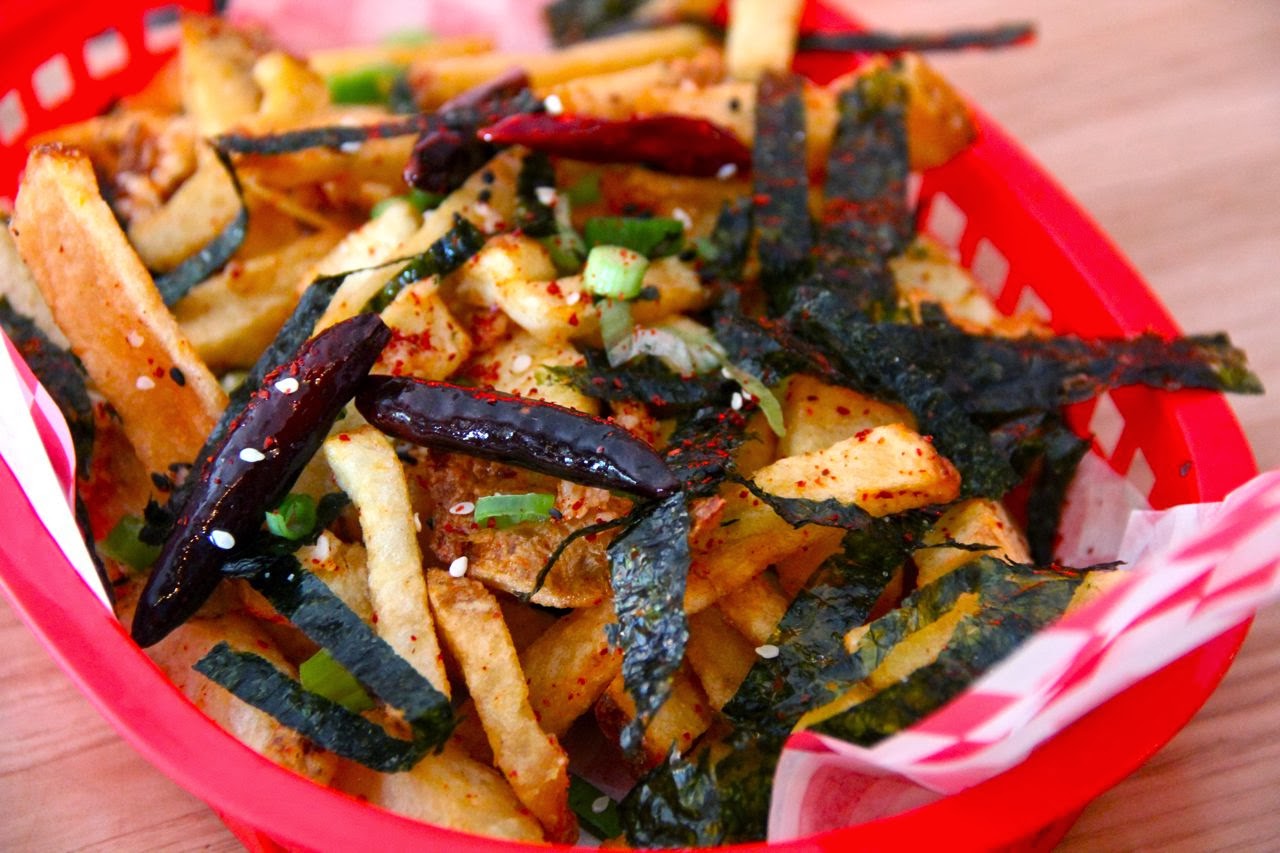
    Hubby really wanted to try “Hand-cut Seoul Fries” ($5). The homestyle fries were smothered with minced garlic and topped with toasted Korean chilies, green onions, thin strips of roasted seaweed, and black and white sesame seeds.

    Accompanying the basket of fries was a small dish of kimchi-topped aoli for dipping. As someone who loves to dip French fries in mayo, this aoli was a fun kick in the pants.

    The minced garlic on the fries had been massaged with 고추가루 gochugaru (spicy red pepper powder), doubling the lip-tingling fire. I liked the savory saltiness brought by the the seaweed rather than just salt.

    Shortly after we put in the order for the Seoul Fries, the entire restaurant smelled like garlic. I wouldn’t be surprised if our clothes smelled of garlic when we walked out. Our breath certainly did and the diet coke and water I drank with my meal did not put a dent in that breath.

    pickle+chips+in+spicy+dipping+sauce31

    Korean pickling is something I’ve come to love in the past decade and a half, but traditional Euro-American cucumber pickles are my comfort food of yesteryear. So I really wanted to try “Fried Sonoma Brinery Pickles with Sausalito Springs watercress” ($5). The batter was delicate and crisp, and the pickle slices were not soggy or greasy.

    With more kimchi aoli for dipping, this was not a low-calorie start to our meal.

    LA+kalbi+mac+and+cheese 231
    LA+Kalbi+mac+and+cheese31

    For the main course, I ordered “LA Kalbi Mac & cheese” ($10). Instead of the typical yellow cheddar macaroni sauce — or otherworldly neon orange-yellow of box-based preparations — this dish topped the hollow pasta elbows with with white cheese sauce.

    Topping the noodles were Los Angeles-style 갈비 kalbi (barbecued beef ribs), generous garnish of fresh 고수 gosu (cilantro or coriander), sliced green onion, buttered toast. The onion and cilantro thankfully provided extra character to what can be a bland noodle dish.

    The kalbi was grilled — with the smokey char marks to prove it — yet the meat was still tender and succulent, while still being cooked completely. A hint of fruitiness, particularly cherry, in the marinade makes me think it contained Dr. Pepper or a similar soft drink. That certainly would match the diner theme of the decor and the menu.

    fried+chicken31

    Hubby ordered Blomster’s–Hi Five’s signature dish, “KFC (Korean Fried Chicken/Crack)” ($15). The teriyaki-style barbecue sauce on the crisp-breaded leg and wing was thankfully more honey-like in flavor and texture, rather than overly sweet.

    Accompanying the chicken was a soy, ginger and vanilla coleslaw, garnished with sliced radish.

    Dick Blomster’s Korean Diner

    16236 Main St., Guerneville, Calif.
    707-869-8006
    Hours: Sunday–Thursday, 5–10 p.m., Friday–Saturday, 5–11 p.m.

  • BCD Tofu House – Los Angeles

    BCD Tofu House – Los Angeles

    BCD Tofu HouseBukchang-dong (or BCD) Tofu House has been one of the most popular Korean restaurants for years. I believe it’s one of those rare Korean restaurants that was born in America and made its way back to the Motherland, Korea. They have 15 locations in and around the Los Angeles region, New York, New Jersey, Seattle, and Seoul.

    The BCD Tofu House was how most Los Angelinos in the late 1990’s and early 2000’s learned about Korean food. For the non-Koreans, the concept of ordering one main dish and have it accompanied by various side dishes was a big treat.

    Non-GMO Soy Tofu at BCD Tofu House

    I always try to make it a point to visit BCD Tofu House whenever I’m in Los Angeles or the surrounding regions. They serve some of the best 순두부찌개 Soft Tofu Stew and I know the ingredients are 100% legit. The House brand tofu is made with Non-GMO organic soy bean tofu. The seafood/beef bone broth and the various banchan side dishes are made without MSG. I can trust this place.

    BCD Tofu House Menu

    As far as the price is concerned, it’s very fair. A bit on the cheap side, especially those Soon Tofu Combos. I would highly recommend the Pork Bulgogi and Soon Tofu combo, but the bibimbap combo ain’t half bad either!

    The spread before the main dish

    On this occasion, we ended up ordering the 게장 Blue Crab in Spicy Marinade, 돼지불고기 Spicy Pork Bulgogi, and 김치 순두부 Kimchi Soon Tofu. Of course, we got the mixed grain rice, which is optional at no extra cost. Soon after the order is received, the waitress ajummas brings out your rice and banchans. Unlike most restaurants, BCD starts you off with 굴비구이 pan fried young yellow fish. All the banchan served has good flavor, but the yellow fish and spicy pickled clams/squid are just work of art!

    Spicy Pork BulgogiThe Spicy Pork Bulgogi is not too spicy, not too sweet, and has the right amount of flavor. The meat itself is very tender and the marinade/sauce is not overpowering. Very good!

    Crab in Spicy MarinadeI’m not a crab fan, but for the crab lovers and/or many other Korean food lovers, this stuff is known as 밥도둑 – aka rice thief. You can ask your Korean friends about the meaning of that term or you may leave us a comment below.

    Kimchi Soon Tofu StewKimchi Soft Tofu Stew… Quite possibly the second favorite comfort food among Korean people. At least for me, it is…

    Be sure to visit BCD Tofu House at any of their numerous locations. From the menu, price, food quality, cleanliness, to the restaurant design, this is a place that I can proudly refer to anyone who is looking for a genuine Korean dining experience. Without any of that ‘luxury’ or some faux high concept Korean food that they are beginning to roll out, the BCD Tofu House is exemplary. Please visit http://www.bcdtofu.com to find the most convenient location to you or your traveling destination.

    Bukchang-dong (BCD) Tofu House

    <iframe src=”https://www.google.com/maps/embed?pb=!1m16!1m12!1m3!1d46211.313704040964!2d-79.5529653921498!3d43.62304818815595!2m3!1f0!2f0!3f0!3m2!1i1024!2i768!4f13.1!2m1!1sBukchang-dong+(BCD)%C2%A0Tofu+House!5e0!3m2!1sen!2skr!4v1521638583249″ width=”600″ height=”450″ frameborder=”0″ style=”border:0″ allowfullscreen></iframe>


  • Palsaik Korean BBQ – Los Angeles

    Palsaik Korean BBQ – Los Angeles

    Palsaik Korean BBQ

    I would like to deeply apologize, to all the ZenKimchi followers, for my long absence. I’ll be more diligent in posting more often.

    One of the representative Korean foods is 삼겹살 (samgyupsal), uncured pork belly, or the Korean bacon. As a matter of fact, samgyupsal’s popularity among Koreans would rival kimchi and ramyeon (instant ramen). Being that popular, it’s no suprise that there are more Korean BBQ restaurants than there are 7-Eleven stores in the Los Angeles Koreatown Area. But, one of them truly stands out – the Palsaik Korean BBQ.

    The inside decor is very modern and somewhat industrial. This is a very welcome change from most Korean restaurant decor, which sort of looks like a hodge-podge of different themes and/or tries to mimic the old hanok or jumak look.

    Inside Palsaik BBQThe name literally means ‘8-colors’. The 8 colors are represented by marinating their samgyupsal in 8 kinds of marinades – original (no marinade), garlic, curry, wine, herbs, doenjang, gochujang, and ginseng!

    Palsaik BBQ Samgyupsal

    The ‘Palsaik set’ is $49.99 and is a full meal for 4 adults. The set includes the 8 color samgyupsal (8 strips of thick cut Korean bacon), lettuce for wraps, rice, spicy seafood soup, mushrooms, salad, and other vegetables.

    Palsaik Lettuce OfferingSesame leaves, lettuce, salad, mushrooms (for grilling), and ssamjang (lettuce wrap sauce).

    Palsaik Tabletop Grill

    The friendly staff will come to your table and start the grilling process for you. Notice the slanted grill, so that the fat from the samgyupsal drips down into the bean sprouts and kimchi!

    Palsaik Samgyupsal

    The first four strips of the samgyupsal grilling away, while the diners drool in anticipation… Is there anything better than samgyupsal and kimchi?

    Palsaik Seafood Soup

    The beautiful Spicy Seafood Soup to complete your meal. Flavor was wonderful and clean without being too harsh with garlic or peppers. The seafood was very fresh and they didn’t skimp on the serving.

    Palsaik Wall Decor

    The wall decorations explaining the each flavor of the palsaik marinade and their medicinal effects.

    My personal favorite flavors were curry and doenjang, but all 8 flavors found a champion in our table of 6 people.

    Overall, my impressions of this restaurant is very favorable. This is one of the few establishments that are redefining the neo-Korean food movement in the US. The Korean restaurants in America were mostly owned and operated by middle aged immigrants who tried to operate their businesses on small budgets, resulting in some weird restaurant decor and/or half-hearted food presentation – think typical Chinese restaurants. Only in the last couple of years, the younger restaurateurs are putting more emphasis on not only the quality of the food (by removing MSG from their recipes and offering organic foods), but these neo-Korean restaurants are properly presenting their dishes in a more modern fashion.

    I highly recommend this place for just about any occasion. With about $50, you will have 4 very satisfied people and something to talk about for a few days. And don’t forget to order some makgeoli!

    Palsaik Korean BBQ Restaurant
    863 South Western Ave, Los Angeles, CA 90005

  • Restaurant: Korean BBQ Plus!, Concord, Calif.

    Restaurant: Korean BBQ Plus!, Concord, Calif.

    Serendipity brought me to this restaurant on the east side of the San Francisco Bay area. I had an appointment with friends in Concord early one February morning. By noon, our meeting was over, and I was hungry.

    Rather than waiting until I returned to more familiar territory to eat, I followed my instinct — and my insistent stomach. Tapping “Korean restaurant” into my smartphone map app pointed me toward Korean BBQ Plus!. It was less than a mile from where I was and from an onramp for Interstate 680, my ticket home. That recommendation hit the spot.

    One of my brave friends came with me. She has very limited experience with Korean food and felt more comfortable with an “expert.” Since I had not done any preliminary research on this restaurant, I had no idea what we would find.


    Korean BBQ Plus! is tucked into a small shopping center and was a little challenging to find. The restaurant shares a building with a small Korean grocery store and a Mexican restaurant. Across the parking lot is a larger Mexican grocer.

    As we walked in the Korean restaurant, I quickly noticed that almost every table was full at 12:30 on a Friday afternoon. That was a promising sign.

    The waitress quickly brought menus and cups of hot barley tea — a beverage I’ve had to ask for at other restaurants. That was promising sign No. 2.

    The lunch menu had a good assortment of standards such as 비빔밥 bibimbap (a bowl full of meat or dubu (tofu) as well as vegetables over rice), 닭구이 dak gui (spicy sweet marinaded chicken) and 된장 찌개 doenjang jjigae (fermented soybean paste stew). However, my friend and I ordered 돌솥 비빔밥 dolsot bibimbap (bibimbap in a hot rock bowl; $12.95) off the dinner menu.

    Among the dozen-plus bowls of 반찬 banchan (side dishes) that came out first were baechu kimchi (cabbage kimchi), radish kimchi, egg omelette with ham, cucumber pickle, mung bean sprouts, soybean sprouts and soy sauce–marinaded sweet potatoes.

    Dolsot bibimbap came with topped with bulgogi, cucumber pickle, soybean sprouts, enoki mushroom, shredded carrot, mushroom, spinach and a raw egg cracked open on top.

    The raw egg excited me way too much, because it was an authentic touch. Most Korean restaurants I’ve visited in the Bay Area fried the egg sunny side up then add it to the bowl, so only the yolk needs to be cooked on the side of the hot bowl.

    My friend was far more excited about the crunchy rice at the bottom of the bowl. It gets that way when the cooked rice fries in a little oil put in the bottom of the very hot bowl.

    I squirted onto the fixings in my bowl a generous amount of 고추장 gochujang (spicy red pepper paste) from the squeeze bottle. (Red squeeze bottles on Korean restaurant tables likely aren’t filled with ketchup.) My friend made a tamer mix of soy sauce and gochujang.

    It also came with a small bowl of 미역국 miyeok guk (seaweed soup). The soup had a full body to it with a little touch of beef.

    Between the dolsot bibimbap, generous banchan and the soup, I left the restaurant satisfied. Korean BBQ Plus! is a good ambassador for traditional Korean cuisine.

    As we were finishing our meal, my friend asked me, “Would you come down here again just go to this restaurant?”

    “No,” I answered honestly. Concord is a 90-minute drive from my home, and there is a traditional Korean restaurant just 20 minutes away.

    However, when I’m in Concord area on business, I will arrange my schedule so I can return for lunch or dinner, hopefully with my patient photography-loving husband in tow.

    Is there a Korean food experience that you would drive (or even fly) a long distance just to experience repeatedly? Tell us about it in the comments section below.

    Korean BBQ Plus!
    1450 Monument Blvd
    Concord, CA 94520
    (925) 680-9090
    Hours: Monday–Saturday, 10 a.m.–10 p.m.; Sunday, 11 a.m.–10 p.m.
    koreanbbqplus.com

  • Hidden kimchi: Java Hub, San Anselmo, Calif.

    Hidden kimchi: Java Hub, San Anselmo, Calif.

    Many assume the territory between San Francisco and Sonoma County wine country an hour’s drive north is bereft of Korean cuisine. I did, too, until I discovered one long-disguised as a coffee shop.

    JavaHubrestaurant41

    Java Hub Cafe is Marin County’s only noted venue for Korean victuals. It’s a simple coffee shop in San Anselmo, Calif., a suburb of San Rafael located about 10 minutes north of San Francisco’s Golden Gate Bridge. And it is well off the beaten tourism path of Highway 101, the Marin-Sonoma thoroughfare.

    On entering the little cafe, I noticed the subtle sounds of acoustic modern folk and alternative music playing subtly from speakers. The large counter has a big posted menu from which to order.

    Indoor seating is on barstools with a long table facing a large window. That’s nice natural lighting for food photography, but it offers an unimpressive view of the regular stream of traffic.

    Outside there are more than half-dozen tables. It would be nice to enjoy coffee and a meal alfresco in the summertime. However, it’s now winter in California. Even though our winter days are mild compared to Korea’s, I still didn’t want to eat outside.

    Tucked behind the coffee shop edifice is a restaurant serving all sorts of North Asian cuisine, including 갈비 kalbi, 비빔면 bibimmyun and miso udon.

    JavaHubbibimbap11

    After waffling between ordering bibimmyun or bibimbap, I initially ordered the spicy bibim noodles (called bibimmyun in Korean, $7.25 USD). But owner Joyce Jung immediately advised me it would take about 20 minutes to make it. I asked if the bibimbap ($6.50 USD) would arrive more quickly, and she said “yes.” So I opted for the popular Korean dish.

    The bibimbap arrived in a regular ceramic bowl — not the oven-heated stone bowls of dolsot bibimbap — with steamed white rice, raw shredded carrot, sauteed mushrooms, steamed broccoli, a sunny-side-up fried egg and a couple of tablespoons of 고추장 gochujang.

    After thoroughly mixing items together with the supplied fork. The raw carrots and lack of marination of the ingredients made the Java Hub version not as sweet and garlicy as the dish often is in traditional Korean restaurants.

    JavaHubbroccolibibimbap1

    Non-Korean vegetables such as broccoli may surprise some, but as a big fan of broccoli I enjoyed it very much.

    Jung told me Java Hub has been open at this location for 10 years. Originally she only served coffee, tea and typical coffee shop fare like bagels and sandwiches. However, she soon found she needed to offer something more to keep the doors open.

    “I noticed that business dropped off in the winter, and I started offering hot meal options to draw winter business,” she said.

    So she began offering familiar Korean and Japanese dishes to her menu as well as other hot items like hamburgers.

    The mix of coffee joint and Korean restaurant may seem eclectic. Yet while I was talking to Jung after my meal, one of her customers, waiting for his “usual order” of a bacon cheeseburger, opined, “Her burgers are the best anywhere.”

    If 빨리 빨리 bbali bbali (“Hurry, hurry!”) is your battlecry and you just want a quick coffee to go, you can place your order from the drive-through window. Jung makes the coffee herself and will bring your order to your car.

    [googleMap name=”Java Hub”]60 Greenfield Avenue, San Anselmo, CA[/googleMap][googleMap name=”Java Hub”]60 Greenfield Avenue, San Anselmo, CA[/googleMap]

    Java Hub Cafe

    60 Greenfield Ave.
    San Anselmo, CA 94960
    (415) 451-4928

  • Seoul Garden, St. Louis

    Seoul Garden, St. Louis

    I haven’t visited St. Louis in 18 years, and I certainly don’t remember the city for its Asian food. So it was a treat to eat at a Korean restaurant there during a recent 20th high school reunion trip to rural southern Illinois.

    St. Louis is the nearest major metropolitan area with a sizable airport to my little hometown, located more than an hour east. After a long flight, my husband and I were hungry. On my asking about nearby Korean restaurants, the hotel clerk directed us to one about a mile away in the suburb of St. Ann.

    SeoulGardensign1

    The first thing we noticed at Seoul Garden was the full parking lot on a Friday night. This was the first good omen; the second, a dining room full of Korean-speakers. Many were feasting on the $20 all-you-can-eat beef, chicken or pork Korean barbecue.

    More tired than hungry, we chose lighter meals. I ordered chicken fried rice (닭복음밥 dak bokeumbap) made with peppery grilled chicken, Chinese restaurant–style peas and diced vegetables (carrots, corn, green and red bell pepper). I was a little disappointed they didn’t sneak any kimchi into the fried rice. The dish came with a small salad.

    SeoulGardenkimchijjigae1
    Kimchi Jjigae at Seoul Garden (Tammy Quackenbush photo)

    My husband ordered a hanshik (Korean food) standard, kimchi stew (김치찌개 kimchi jjigae). This one contained enoki mushrooms, a couple of slices of fish cake as garnish and hidden slices of rice cake (가래떡 garae tteok). It had the expected spiciness and sourness as well as welcome warmth for that cool fall evening.

    Thanks to the mealtime custom of multiple side dishes (반착 banchan), diners at many of the more traditional restaurants can sample the multiple personalities of Korean cuisine. Every time I visit a restaurant for the first time, I get more excited to discover the banchan than my main course.

    Among the banchan at Seoul Garden was a bowl of Gyeran Jjim (계란찜), which is a Korean egg custard. This was the first time on either side of the Pacific I’ve had it served as banchan. It was as comforting a dish as it was simple — two scrambled eggs and one cup of a simple broth (such as anchovy or dashida), baked or steamed until set.

    SeoulGardenlotusroot1
    Yongeun Jorim as banchan (Tammy Quackenbush photo)

    Another side dish surprise was marinated sliced lotus root, called Yongeun Jorim (연근 조림). It was pleasantly crunchy, sweet and salty.

    It’s a pity we had to leave the next morning for my reunion. It’s even more of a pity the early time of our return flight precluded our stopping there for one more meal.


    Seoul Garden

    10678 St. Charles Rock Road
    St. Ann, MO 63074
    (314) 429-4255
    Hours: Monday–Saturday, 11 a.m.–10 p.m.

     
  • Wa! Ssada Restuarant – Los Angeles

    Wa! Ssada Restuarant – Los Angeles

    Wa! Ssada combo plate

    Let’s test your ‘gringo-ness.’

    When someone says sushi, what comes to your mind?

    If you said raw fish, then congratulations – you’re one of the truest of the true gringos. Sushi is the vinegared rice that the slices of raw fish, or any other toppings, rest on.

    Ok, then what do you call the slices of raw fish?

    If you said sashimi, then you’re a well-cultured gringo. Now if you want the elite gringo status, what is sashimi called in Korea?

    회 Hui (pronounced hway) is correct, but more specifically it’s 생선회 Saengseon Hui. If you say ‘hui’ most people will assume that you are, indeed, talking about raw fish.

    Beginning of the dinner experience

    Although they are prepared in the same exact way, there are a couple of huge differences in Korean hui and Japanese sashimi. The most glaring one might be the condiments. Japanese will only serve you soy sauce and wasabi, basically the same stuff that accompanies sushi. Koreans, however, will serve you 초장 chojang – a mix of  고추장 gochujang, vinegar, and sugar. Wasabi and soy sauce are available upon request, if not served up front. The other disparity is that Korean hui is usually a full course dining experience, whereas the sashimi is more like an appetizer to a meal.

    Let me expand on the full dining experience that is 횟집 huitjip – Korean raw fish restaurant.

    One of the most talked about huitjip in Los Angeles is 와! 싸다 ‘Wa! Ssadda’. It is sometimes misspelled as Wassada, especially on the ‘Net, and is mistaken for a Japanese sushi joint. But hey, however you find this place, just get in here!

    Also, forget about the menu. Get either the combo plate or the 광어 Gwang-eo (flounder) hui plate, then you can add live lobster, live sea cucumber, or live abalone as needed. Notice the word live. When you enter the restaurant, you will be surrounded by fish tanks featuring your dinner menu. You can even name the fish before they take it to the kitchen and kill it for your consumption. It’s a good thing that fish do not make any audible noises.

    Wa! Ssada food

    We ordered the combination plate #2 (medium) and a side of lobster. The huge plate consists of sea urchin, abalone, flounder, tuna, salmon, some sea bass, and other fish that I could not identify. But this plate is only a small part of why you go to a huitjip. As soon as you’ve ordered your food, the army of servers come out with various banchan dishes and the beginning of your full course meal.

    264014 10150225285581710 602681709 7615704 6593624 n11

    First to be set on your table are a house salad, sea snails, spicy peanuts, seaweed salad, edamame, raw half-shell oysters, macaroni salad, sweet potatoes, and 전복 죽 Jeonbok Juk (Abalone Porridge). Also, at this time, they bring you lettuce, sesame leaves, sliced jalapeno peppers and garlic, and an array of dipping sauces. As some of you may already know, Koreans love to make lettuce wraps with various greens (organic preferred).

    268456 10150225285656710 602681709 7615706 4842526 n11

    Round 2 – Tuna Tataki is served with monk fish liver.

    261445 10150225285616710 602681709 7615705 1536061 n11

    Round 3 – the lobster arrives with its tail split open, cut up in bite sized morsels and presented back in its shell.

    264233 10150225286081710 602681709 7615714 1758161 n11

    Round 4 – the server brings out the spicy tuna roll.

    Wa! Ssada dinner

    Round 5 – the main course is presented to us on a huge plate the size of a small satellite dish. A sizzling plate of grilled onions and garlic is served for the lettuce wraps.

    261338 10150225286041710 602681709 7615713 2494165 n11

    Round 6 – vegetable tempura time. Also at this time, they take back the lobster to the kitchen to cook it.

    268764 10150225286151710 602681709 7615715 5527539 n11

    Round 7 – the grilled trio of mackerel, salmon head, and mixed fish on a half shell is served.

    264730 10150225286186710 602681709 7615716 7497638 n11

    Round 8 – they bring out the 매운탕 spicy seafood soup made with the leftover flounder from the earlier hui. The staff also offers up our leftover lobster that they have just cooked.

    270114 10150225286226710 602681709 7615717 3336877 n11

    Round 9 – as if all that wasn’t enough food, the fine sushi chefs prepare a spicy kimchi hand roll… for dessert! I will warn you, this stuff is SUPER HOT!!!

    So, there you have it. Since I cannot describe the flavors of all 12-15 dishes, I will just say that all the dishes were excellent in flavor and texture – they were living and breathing just a mere few minutes ago. Our bill came to about $150 for the medium combo plate, a lobster and a couple of Cass beers; for the four of us, it was quite fulfilling. You will eat like there is no tomorrow!

    Lastly, the Korean hui dinner is an experience that everyone should try at least once. The whole experience is not only a feast for your stomach, but your eyes, nose, and mouth will thank you even more.

  • Myungdong Grill Restaurant – San Francisco Bay Area

    Myungdong Grill Restaurant – San Francisco Bay Area

    Kimchi Soondoobu from Myungdong Grill

    Recently, a few of my friends have been asking me where to get the best Korean food in the South Bay (San Jose Area of California). It’s then when my drill down questioning starts, because some places make great soups while others make great meat dishes. It is very rare to find a single restaurant that does all types of Korean food well.

    But for most beginners and/or the uninitiated, I would recommend Myungdong Grill in Santa Clara, CA. Yes, the restaurant is located in the heart of SF Bay Area’s K-Town – El Camino Real and Lawrence Expressway. This place is very unassuming from the outside, as it shares the strip mall space with a 빵굽는 마을 Baking Village and Salvation Army Thrift Store. Once you are able to find it, you will find a clean and contemporary Korean restaurant.

    Japche close-up at Myungdong Grill

    You will find table-top-grill-equipped seating along the walls, and the middle rows feature plain tables. Don’t forget to tell the staff that you want the grilling seats if you are planning to grill – they forget to ask sometimes. The menu covers look like they belong in a museum, as they look and feel substantial.

    I, personally, frequent this establishment on a regular basis. So on this fine evening, my date and I decided to order some 순두부 soondoobu and 해물 파전 haemul pajeon (seafood pancakes).

    Haemul Pajeon from Myungdong Grill

    Let me get my one and only gripe out of the way first. When a customer orders appetizers, such as haemul pajeon, the appetizers are supposed to be served ahead of the main course. This restaurant does not seem to care about that simple rule, because the appetizer dishes have come out along with the main course several times. But, in all honesty, Korean dinner tables do not feature ‘appetizers, per se… that is such a Western cultural thing.

    Mixed Grain Rice from Myungdong Grill

    And now to the good part. I ordered my usual, the 김치 순두부 kimchi soondoobu with average spice level, and my date ordered the extra hot 해물 순두부 seafood soondoobu. The soup dishes at Myungdong Grill are consistently good. Although many people swear by So Gong Dong Tofu House, I feel that the quality of their food has dropped off significantly in the last few years–to be honest, the flavor of SGD Tofu House soondoobu is too much like 신 라면 Shin Ramyun!

    Banchan from Myungdong Grill

    The various 반찬 banchan dishes are also standouts at Myungdong Grill. They are not too sugary and feel like mom’s cooking. The soondoobu has the right flavor and spice level, the texture of the tofu is just spot on, the ingredients are well matched and fresh, and the broth consistency is well above average. Lastly, the haemul pajeon is no joke either – perfectly cooked and the seafood bits were very tasty!

    All in all, I would highly recommend Myungdong Grill to most people. They feature all types of great dishes, especially the soups and grilled meats. You will not be disappointed with the food, however their service can be somewhat of a mixed bag. Even with that said, the service issue will not be a hindrance to your enjoyable dining experience.

    [googleMap name=”Myungdong Grill”]1484 Halford Ave Santa Clara, CA 95051[/googleMap]

  • Review: Korean Village Wooden Charcoal BBQ House, San Francisco

    Review: Korean Village Wooden Charcoal BBQ House, San Francisco

    The restaurant was nearly empty when we sauntered in at 1:45 p.m. on a Sunday afternoon. Two men were engaged in an animated conversation in a Chinese language at a table on the opposite side of the restaurant, their words echoing off the walls and the mirror that stretched the length of one side of the restaurant and over the din of the sports color commentators on the big-screen TV.


    woodenBBQsign31

    Because of the name of the restaurant, we ordered broiled 불고기 bulgogi and broiled barbecued chicken (닭구이) from the lunch menu, which bundles the items with 밥 bap (rice), 반찬 banchan (side dishes) and a bowl of soup. Both entrees were $9.99 each.


    woodenbanchanspread21

    The banchan were typical Korean restaurant fare: baechu kimchi, lightly pickled cucumbers, marinaded soybean sprouts,  marinaded mung bean sprouts, soy sauce–brined jalapeños, and two kinds of daikon kimchi (one was fresh and the other was made from dried daikon). They were tasty but not surprising.


    woodenbbqseaweedsoup11
    Miyukguk, a simple Korean seaweed soup (Tammy Quackenbush photos)


    The surprise for us were the small bowls of 미역국 miyukguk, which is a Korean seaweed soup made with wakame in a simple broth. Of all the soups in Korea’s culinary repertoire, few are more Korean than miyukguk. I have to give the restaurateurs credit for serving such a bold, unusual dish to a couple of non-Koreans, since many non-Koreans are still somewhat squeamish about seaweed in its leafy form.

    Korean women recovering from childbirth are served this soup morning, day and night for the first couple of weeks after giving birth. Some Korean women are also compelled by well-meaning relatives to eat lots of it leading up to childbirth, since is it believed to purify the blood and help women with lactation.

    The waitress set the bowls down, I looked at my husband and said “Happy Birthday,” though neither of us have a birthday coming. He doesn’t like seaweed in soup or 김밥 kimbap (sushi).

    “It’s good for me, right?” he asked me while stirring the leaves and looking skeptically into the bowl. He ended up liking the flavor of the soup.

    The service was prompt. The waitress took our order shortly after we sat down and brought the banchan, rice and soup within a few minutes. The bulgogi and grilled chicken arrived a few minutes after that.

    The bulgogi was quite dry, and the smoke flavor from the real wood oven was pronounced. We dipped the meat in the miyukguk and wrapped it in moist rice, which helped.

    The chicken, however, was moist, the “special house sauce” more obvious than on the bulgogi, and the smokiness more subtle.

    Korean Village Wooden Charcoal BBQ House, or Wooden Charcoal BBQ, is located in San Francisco’s Inner Richmond neighborhood at 4609 Geary Blvd.

    It is easy to find from Highway 1, commonly known as 19th Avenue, a major north-south thoroughfare on the west side of the city. If you’re traveling north on 19th Avenue (coming north from San Francisco International Airport and San Jose on Interstate 280), turn right on Geary Boulevard. The restaurant will be on your right between 10th and 11th avenues.

    Making left turns on a number of streets of San Francisco is difficult. If you are traveling south on Park Presidio (from Napa-Sonoma wine country and the Golden Gate Bridge), you can’t turn left onto Geary. Travel a block south of Geary, turn right onto Anza, turn right at 14th Avenue then turn right a third time, onto Geary

    This restaurant is worth the hastle. Parking is available along Geary or side streets.

    Geary Boulevard has a string of Korean shops, grocers and restaurants. Wooden Charcoal BBQ is about a block away from longstanding Korean barbecue master Brothers Restaurant and several blocks from the Korean establishments in Japantown.